
Every day, Utah’s payers, providers, state agencies, and researchers need information that lives in someone else’s systems. Building those connections between systems can be costly. Ensuring that the data can be shared legally, securely, and respecting patient’s preferences takes time and money. Using UHIN as the connection mechanism means saving costs by letting them make the connections and form the agreements that will govern the healthcare ecosystem. UHIN serves as the neutral steward that makes data available to the people who need it.
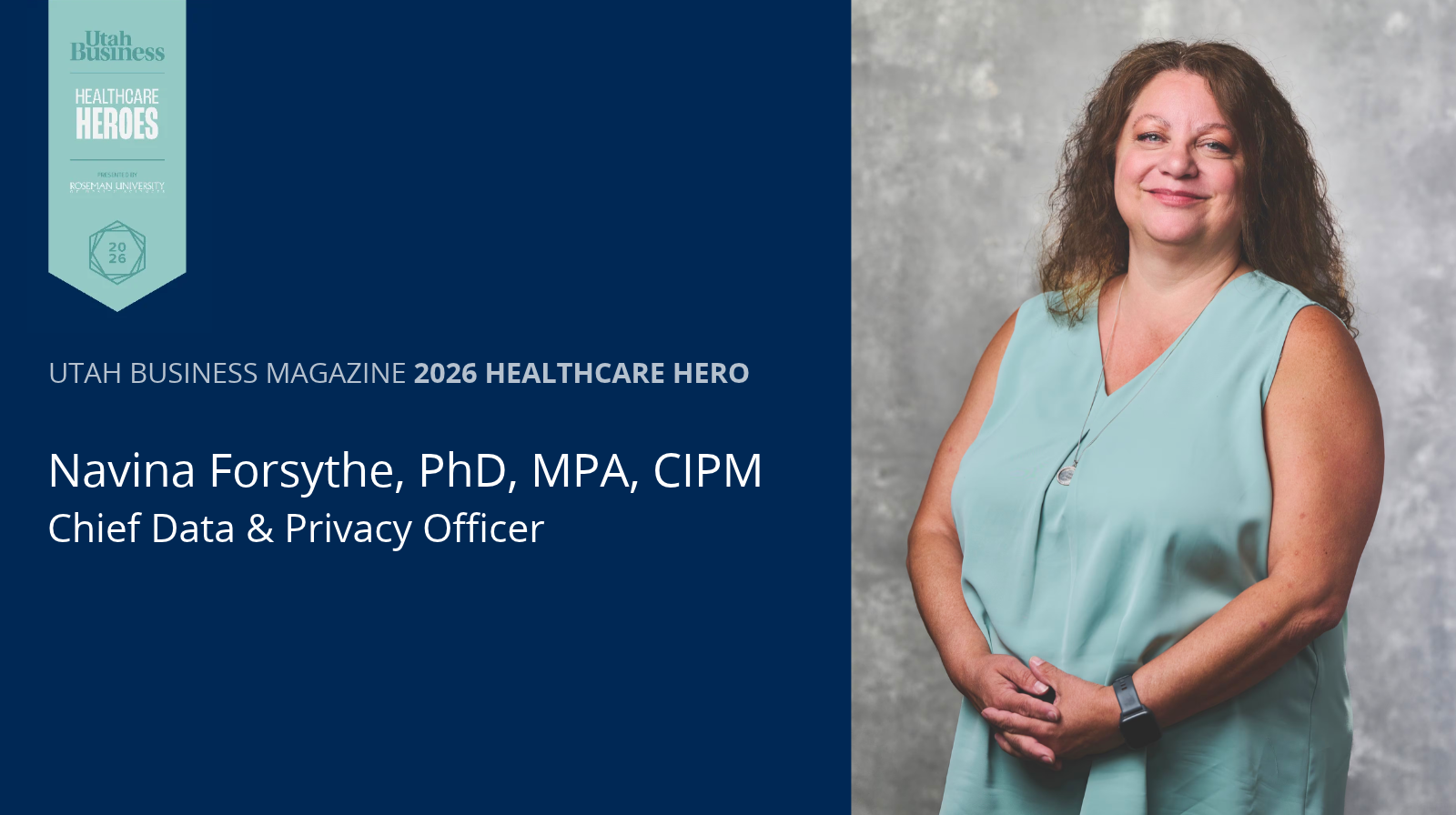
This month, Utah Business named Navina Forsythe, PhD, MPA, CIPM, UHIN’s Chief Data & Privacy Officer, one of its 2026 Healthcare Heroes. We could not be prouder, and we can’t think of a better illustration of why neutrality matters.
A career spent on every side of the data
Navina’s path to health data is not a typical one. She started in 1989 on a crisis phone line at the University of Utah. She went on to counsel adolescents in crisis, investigate cases for Child Protective Services, and practice as a licensed psychologist. At the Division of Child and Family Services, she helped take an agency running on paper files and an aging mainframe and gave it the ability to see outcomes from a single case up to the whole state. As Division Director of the Utah Department of Health’s Center for Health Data and Informatics, she oversaw Vital Records and Statistics, Health Care Statistics, Public Health Assessment, and Health Informatics.
She has been the caseworker who needed the record, the state director accountable for public health data, the researcher asking for access, and the review board chair deciding whether to grant it. That range is exactly why she is trusted with what UHIN holds. She knows what a clinician loses when information is withheld and what a patient loses when it is shared carelessly, and she weighs both.
Neutrality is something you practice, not just claim
UHIN is a nonprofit founded in 1993 and Utah’s state-designated health information exchange. We have no shareholders, and all of our net income goes back into the services our members depend on. That structure makes neutrality possible. Navina is a big part of what makes it real.
Since 2022, she has led data strategy, governance, and privacy at UHIN and serves as executive over Utah’s state-designated Clinical Health Information Exchange (CHIE). She holds the Certified Information Privacy Manager credential and has chaired institutional review boards for two Utah state agencies. She recognizes that while data is essential to inform positive outcomes, its use needs to be balanced with respect for privacy and patient’s right for autonomy.
Her position is not that data should be locked down. Broad, responsible sharing is how costs come down and care improves. That sharing only stays possible if the trust behind it is earned every day.
What neutrality makes possible
Because Utah’s health system trusts a neutral steward, it already has infrastructure that connects most of Utah’s health ecosystem. Nearly every hospital in Utah participates in UHIN. In the twelve months ending June 30, 2026, UHIN processed roughly 363 million inbound transactions, answered approximately 91 million patient record queries, delivered about 4 million clinical results, and sent roughly 40 million alerts.
Utah does not need to reinvent that. Every new integration or parallel data warehouse costs money and splits the state’s data into one more place that has to be reconciled later. The better path is to invest in what already exists and put it to work.
Bad patient data is a hidden tax
When the same patient exists as four slightly different records across four organizations, someone pays for it. Tests get repeated. Claims get denied. Staff spend hours calling records departments. Clinicians make decisions with half the picture.
One widely cited industry survey found duplicate records added an average of $1,950 per patient per inpatient stay and attributed roughly one-third of denied claims to inaccurate patient identification.1 Nobody sends an invoice for that waste. It shows up in premiums, in staff time, and in delayed care, and it falls hardest on the small, independent practices that can least afford it.
UHIN works to match and validate patient records of various quality and completeness from different healthcare entities so that what comes back is one patient, not four versions of one. Better data quality is one of the most direct ways to lower the hidden cost of care in our communities and UHIN leads efforts to improve the data quality and interoperability that all health care entities are responsible for.
From exchange to strategic data intelligence partner
Moving records from point A to point B is the foundation. The bigger opportunity is what Utah can do with trusted, high-quality data once it exists.
That is already happening. Granger Medical used CHIE alerts to cut its transitional care readmission rate from 23 percent to 9 percent. Home health and hospice agencies rely on it to avoid delays in patient care. Behavioral health agencies use it reach out to clients with support after a crisis. UHIN’s recent work also includes advancing interoperability in rural Utah and using health information exchange to improve chronic kidney disease outcomes.
If your organization has a question your own data cannot answer, about readmissions, care gaps, population health, or the patients you share with others, we want to hear it. That is where the next use cases come from.
Invisible by design
Navina’s work is invisible by design. The better the exchange runs, the less anyone notices it. There is no ribbon cutting for a record that arrived on time, and no press release for a readmission that never happened.
“Navina brings a rare combination of technical depth and real commitment to the communities we serve,” says Brian Chin, CEO of UHIN. “She’s kept us anchored in our role as a trusted, neutral partner in our community and never lets us lose sight of the patients and healthcare organizations on the other end of the data.”
Congratulations, Navina, and thank you for keeping the trust that makes all of this possible.
1. Black Book Research, patient identification and EMPI user survey of 1,392 health technology managers, Q3 2017 to Q1 2018, as reported in “Black Book Report Highlights Patient Identification Issues,” Healthcare Innovation, April 11, 2018. Also cited in Grannis SJ et al., “Evaluating the effect of data standardization and validation on patient matching accuracy,” Journal of the American Medical Informatics Association 29(8), 2022.